
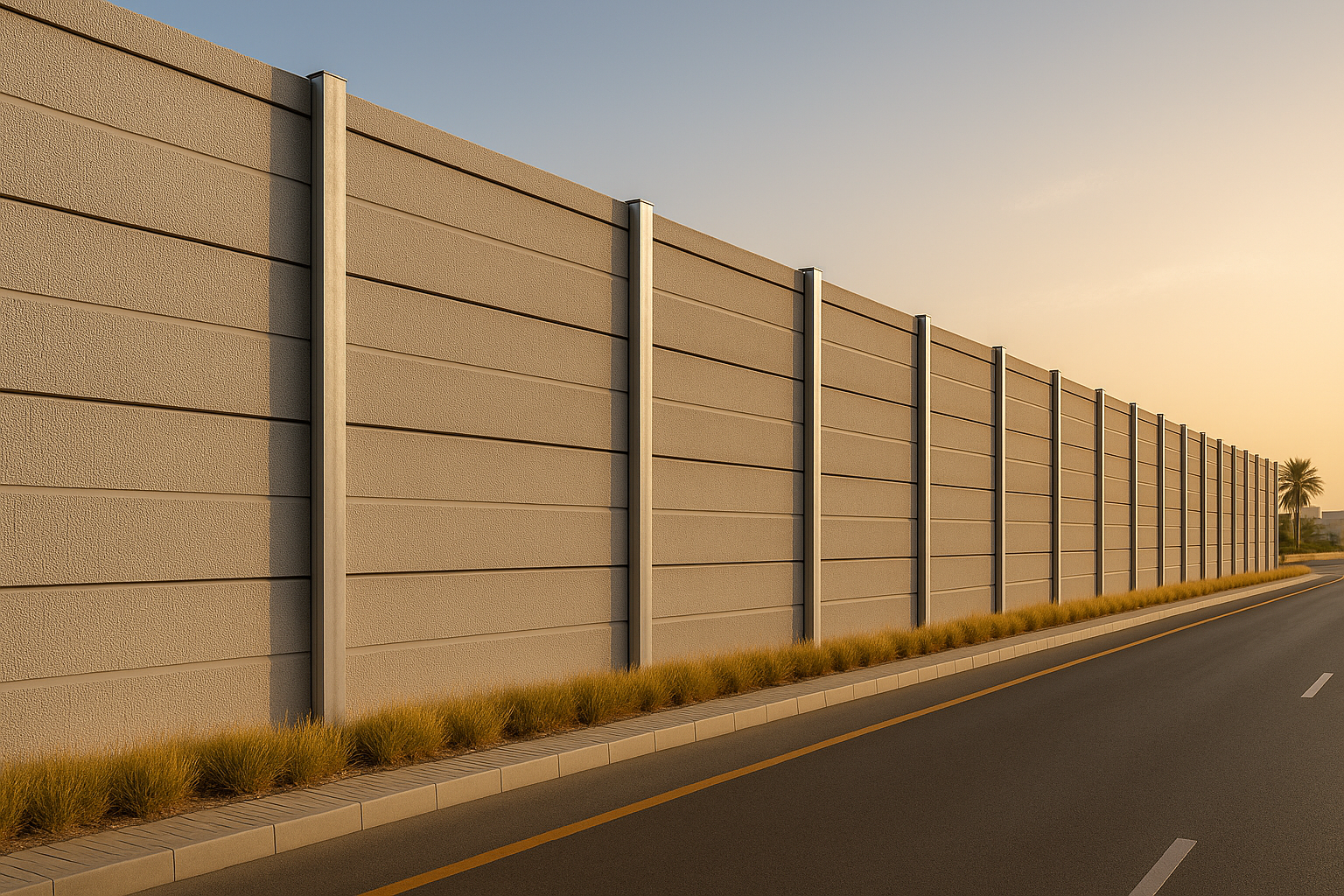
Noise Mitigation Walls
Acoustic Sound Barrier Walls in Saudi Arabia
Acoustic sound barrier walls reduce noise only when the barrier line is continuous, joints are sealed, and height strategy matches the site. If it has gaps, it will leak sound like an open door.
What this page covers
This page covers acoustic sound barrier walls for roads, industrial boundaries, and sensitive sites. These are not standard boundary walls—noise mitigation requires performance panels, continuity, and disciplined installation.
What a proper acoustic barrier should achieve
- Reduced exposure: measurable improvement when the system is designed correctly.
- Continuous barrier line: sealed joints and controlled transitions to prevent leakage.
- Durable performance: materials selected for harsh outdoor exposure.
- Site compatibility: planned around access points, utilities, and safety constraints.
- Clean finish: professional appearance suitable for public-facing zones.
Typical specifications
Where acoustic barrier walls are used
- Urban roads: traffic noise mitigation near residential and commercial areas
- Industrial sites: boundaries near equipment zones and operations
- Infrastructure: utilities and controlled facilities where noise matters
- Commercial boundaries: sensitive neighbors requiring noise support
- Workforce zones: protecting rest and office areas near operations
Specify these to avoid failure
- Noise source + protected zone: define what you’re blocking and what you’re protecting.
- Continuity: joints, corners and transitions planned to stay sealed.
- Height strategy: height aligned to the site and the protected zone.
- Access points: gates planned without creating big leakage paths.
- Durability: finishes selected for sun, dust, and wear.
Installation approach
- Site survey
Boundary measurement and constraints mapping. - Planning
Height strategy, continuity and access coordination. - Structural preparation
Post layout and base planning for exposure. - Panel installation
Controlled joints and alignment checks. - Handover
Final inspection aligned to scope requirements.
Frequently asked questions
Do acoustic barrier walls actually reduce noise?
Yes, when the barrier line is continuous and height strategy matches the site. Gaps and poor joint sealing destroy performance.
Are acoustic walls the same as boundary walls?
No. Acoustic walls use performance panels and detailing for noise mitigation. Standard boundary walls often fail to deliver meaningful reduction.
What is the most common reason sound barriers fail?
Discontinuity—gaps, openings and poor joint sealing. Wrong height strategy is the second common failure.
Can you integrate gates without ruining performance?
Yes. Access points can be planned with detailing that reduces leakage and maintains continuity as much as practical.
What other wall fencing should I compare?
If your priority is privacy first, compare Concrete Panel Fences.