
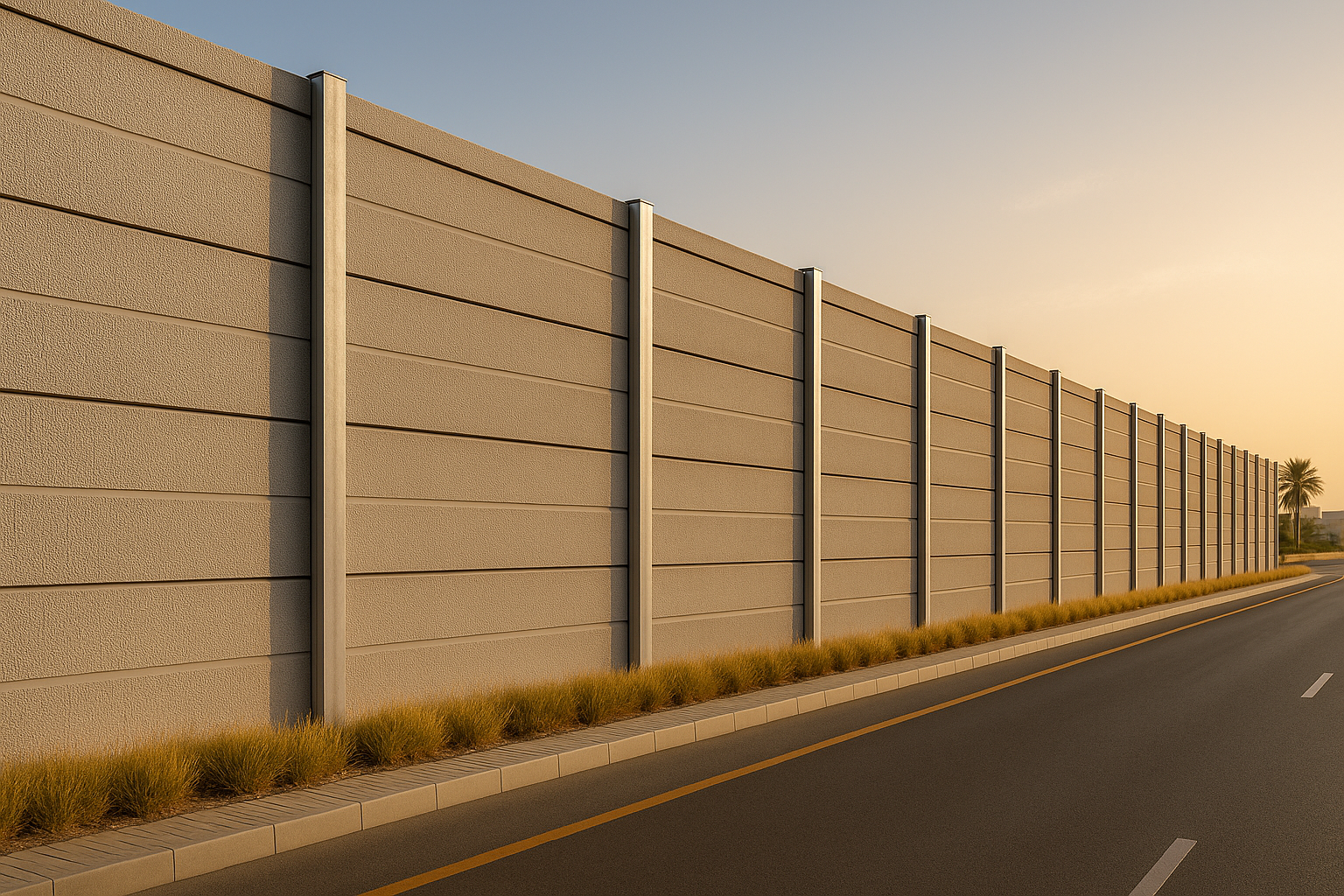
Privacy-First Boundary Walls
Concrete Panel Fences in Saudi Arabia
Concrete panel fences are chosen when privacy and perimeter strength matter more than visibility. The difference between “solid” and “problem” is anchoring and alignment heavy panels punish weak bases and sloppy runs.
What this page covers
This page covers concrete panel fences used for villas, compounds, service yards and industrial boundaries where you want a solid privacy barrier. These systems use precast panels with engineered posts and stable bases to keep the line straight and the joints consistent.
Why concrete panel fencing is chosen
- High privacy: blocks direct sight lines and defines a clear boundary.
- Stronger perimeter: heavier barrier compared to lightweight fencing systems.
- Lower attention ownership: durable structure with straightforward upkeep.
- Better screening: hides yards, equipment zones, and back-of-house areas.
- Cleaner site look: a straight, level run reads premium.
Typical specifications
Quality factors that decide success
Anchoring is the system
Precast panels are heavy. Weak bases and rushed post setting lead to movement, cracks at joints, and visible drift. If anchoring is wrong, the fence will punish you later guaranteed.
Alignment is not cosmetic
A concrete fence looks expensive only when it’s straight and level. Bad levels and uneven joints make the best panels look cheap. Layout control is the difference between “installed” and “engineered.”
Common applications
- Residential privacy: villas, side yards, garden boundaries
- Compounds: perimeter definition with controlled access points
- Industrial sites: service yards, storage plots, factories and warehouses
- Screening: back-of-house equipment and waste areas
- Noise support: solid boundaries can help compared to open fencing (site dependent)
Options and upgrades
- Height selection: choose height based on privacy and exposure.
- Textured panels: finishes that improve street-facing appearance.
- Paint coordination: finishing guidance for cohesive facades.
- Gate integration: access points aligned to daily operations.
- Security coordination: planning for lighting and camera lines of sight.
Installation approach
- Site survey
Measurement, levels, corners, and access points. - Layout planning
Fence line marking, height selection, and gate coordination. - Base and post setting
Anchoring plan aligned to ground conditions. - Panel installation
Consistent joints and alignment control. - Handover
Final inspection and scope documentation.
Frequently asked questions
Do concrete panel fences improve privacy?
Yes. Solid panels block sight lines and create a clean, defined boundary.
Do concrete panel fences reduce noise?
They can support noise reduction compared to open fencing. Results depend on height, continuity, and site layout.
What matters most in installation?
Anchoring and alignment. Correct base work keeps the fence stable, and controlled layout keeps runs straight and joints consistent.
Can you integrate gates and access points?
Yes. Gates and access points can be planned so the perimeter stays practical without ugly transitions.
What should I compare it with?
If you need noise mitigation specifically, compare Acoustic Sound Barrier Walls. For cost-effective open perimeters, compare Chain Link Fences.